Unified Commerce: A Beginner's Guide for Retailers
Learn what unified commerce is, how it differs from omnichannel, and why it matters for modern retailers. Discover the key benefits, features, and best practices with UniSouk.
July 15, 2026
Your customers don't shop in one straight line anymore. They might discover a product on Instagram, compare prices on Amazon, buy through your website, and return it at a store.
Unified commerce gives you one connected system for sales channels, inventory, orders, payments, and customer data. You need it when a traditional ecommerce setup can't keep up with shoppers who expect accurate stock, flexible delivery choices, and easy returns. Platforms such as UniSouk help bring those moving parts into one place.
What Is Unified Commerce?
Unified commerce is a retail model where every sales channel and back-office system shares the same real-time data. Your website, marketplace listings, physical stores, warehouse, payments, and customer records work from one source of truth.
That shared data includes products, prices, stock levels, customer profiles, orders, payments, delivery updates, and returns. When something changes in one place, connected teams and channels can see it right away.
Selling on several channels isn't enough. You can sell on Shopify, Amazon, Instagram, and in-store while still using separate spreadsheets, dashboards, and order tools. That's multichannel selling. Unified commerce connects the operation behind those channels.
How a Unified Commerce System Works
A customer takes an action, such as placing an order on your website. The platform records it, reserves stock, sends the order to fulfillment, updates payment status, and adds the purchase to the customer's profile.
Imagine you sell a shirt through your website, Amazon, and a physical store. When the warehouse ships an online order, available stock updates across all three channels. Your store associate doesn't promise an item that has already sold.
A unified commerce platform may connect ecommerce, point of sale, order management, warehouse management, CRM, and payment systems.
Why Unified Retail Commerce Matters Today
Disconnected tools create small problems that pile up fast. You may see stock mismatches, delayed order updates, repeated data entry, slow fulfillment, and incomplete customer histories.
This gets harder when you sell through Shopify, Amazon, marketplaces, and stores at the same time. With shared operational data, you can make decisions based on the same order, inventory, and customer information your team sees.
One inventory number should mean the same thing to your warehouse team, marketplace manager, and store cashier.
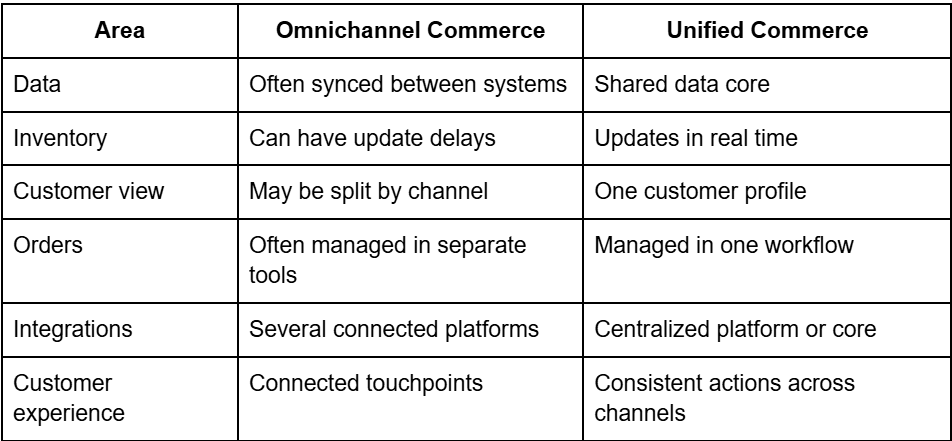
Unified Commerce vs Omnichannel Commerce: What Is the Difference?
Omnichannel commerce focuses on giving customers multiple connected touchpoints. Unified commerce goes further by centralizing the data and operations behind those touchpoints.
The difference matters when a customer returns an online order to a store. An omnichannel setup may need separate systems to sync the return. A unified setup can update inventory, payment status, customer history, and reports through one shared workflow.
In the omnichannel vs unified commerce comparison, the real question is simple: are your channels only connected, or are they working from the same operational data?
The Core Parts of a Unified Commerce Platform
A practical unified commerce solution should connect the systems you use every day. The goal isn't to collect more software. It's to stop the same product, order, or customer record from living in several places.
Centralized Inventory and Product Catalogs
One inventory record can show available stock across warehouses, stores, websites, and marketplaces. It should also handle product details, variants, stock reservations, low-stock alerts, and pricing rules.
Accurate catalog data matters when you sell the same item in several places. A size, color, SKU, or bundle must match everywhere. That helps prevent overselling and confusing product listings.
Unified Order and Warehouse Management
Order management decides where an order should be fulfilled. It may route the order to the nearest warehouse, split items across locations, track delivery status, and support returns across channels.
Your warehouse team then picks, packs, and ships based on the same order data. A connected inventory and order management system helps you reduce manual handoffs between seller operations and fulfillment.
Customer Data, Payments, and Analytics
A unified customer profile brings together purchases, preferences, loyalty activity, support requests, and returns. You can recognize the same customer whether they buy through a store, app, or marketplace.
Connected payments help you track transactions, refunds, and fraud checks in the right order. Dashboards then show which products, channels, and locations perform well.
Multi-Channel Selling and Marketplace Integrations
Your channels may include a website, mobile app, social commerce, physical stores, Amazon, Flipkart, and ONDC. Reliable integrations keep listings, prices, stock, orders, and shipping updates aligned.
With unified commerce capabilities, you can manage multi-channel selling without jumping between separate dashboards all day.
The Biggest Benefits of Unified Commerce
When implementation and data quality are strong, a unified commerce setup can improve both customer service and daily operations.
You can show more accurate stock information across channels
You can fulfill orders faster from the right location.
You can support buy online, pick up in store and cross-channel returns.
You can run consistent promotions without recreating them in every system.
You can reduce manual updates, duplicate entries, and avoidable errors.
You can make decisions with clearer reporting on sales, inventory, and customers.
Results depend on your business size, order volume, data quality, and channel mix. Still, one connected view makes growth easier to manage.
How Unified Commerce Works in a Real Customer Journey
A shopper sees your product on social media and buys it through Amazon or your ecommerce store. Your system reserves stock at the right warehouse and sends a delivery update as the order moves.
Later, the shopper returns the item at a physical location. One unified commerce system updates the order, stock, payment record, customer profile, and sales reports. If you operate multiple warehouses or sell through ONDC, the same shared data helps each channel stay current.
Which Businesses Benefit Most From Unified Commerce?
Fashion sellers can manage size and color stock. Electronics retailers can track serial numbers and warranty-linked returns. Grocery businesses can manage freshness and delivery slots.
Beauty brands can keep product bundles and repeat purchases organized. Furniture sellers can coordinate large-item delivery and returns. D2C brands, quick-service restaurants, and retailers with stores plus online channels can all benefit when separate tools start slowing down daily work.
Signs You Need a Unified Commerce Solution
You may need a unified commerce platform if you sell on multiple marketplaces and update inventory by hand. Frequent stock mismatches, separate order systems, duplicate product records, slow returns, and unclear customer histories are also warning signs.
You don't need every sign before you review your options. As you grow, disconnected systems often become more expensive and harder to manage.
How UniSouk Can Help You Adopt Unified Commerce
UniSouk can help you connect marketplace integrations, inventory synchronization, order management, warehouse workflows, product catalog management, seller onboarding, and analytics through a central workflow.
You don't have to replace every system at once. Start by reviewing your current channels, finding data gaps, and choosing the work that needs attention first. A phased unified commerce implementation can be more practical than a full rebuild.
If you have questions about your setup, you can contact UniSouk for a demo.
How to Choose the Best Unified Commerce Platform
When comparing unified commerce software, look beyond a feature list. Check whether it supports your current sales channels and has real-time inventory, order routing, return workflows, automation, and useful analytics.
Ask about security, user permissions, API support, implementation help, customer service, and future scalability. Request a demo and test common tasks, such as canceling an order, processing a return, or updating stock.
Also confirm data ownership. Compare total cost, not only unified commerce platform pricing. Setup, integrations, customization, support, and training all affect the real cost.
What to Expect From the Future of Unified Commerce
AI can help with support tasks, demand forecasting, and predictive inventory. Voice commerce, faster marketplace fulfillment, hyper-personalized offers, and headless commerce will also shape how customers buy.
None of those tools work well with messy data. A strong connected foundation gives you cleaner product, order, and customer information before you add advanced features. UniSouk can help you build that foundation.
Frequently Asked Questions About Unified Commerce
What Is Unified Commerce?
Unified commerce is a connected approach that brings sales channels, inventory, orders, payments, and customer data into one shared system. It gives you a clearer view of operations and helps customers move between channels with fewer issues.
What Is the Difference Between Omnichannel and Unified Commerce?
Omnichannel connects multiple customer touchpoints, while unified commerce centralizes the data and operations behind them. For example, a store return can update online inventory and the customer's order record at the same time.
What Are the Benefits of a Unified Commerce Platform?
A unified commerce platform can provide more accurate inventory, faster fulfillment, better customer service, lower manual work, and clearer reporting. The results you see depend on your implementation, business needs, and data quality.
Is Unified Commerce Suitable for Small Businesses?
Unified commerce can suit small businesses that sell through several channels or plan to scale. Choose a platform that fits your current budget, order volume, channels, and operational needs rather than buying more than you can use.
How Does UniSouk Help Businesses Implement Unified Commerce?
UniSouk can help you connect marketplaces, products, inventory, orders, warehouse operations, and reporting through a central workflow. You can discuss your channels and requirements with its team before deciding on an implementation path.
How Much Does a Unified Commerce Platform Cost?
Pricing depends on channels, order volume, users, integrations, customization, support, and implementation needs. Compare total cost of ownership, ask about ongoing fees, and request a tailored quote or demo before choosing a platform.
Conclusion
Unified commerce gives you one connected view of products, customers, inventory, orders, and payments across every channel. That helps you reduce errors, serve shoppers better, and scale without losing control of daily operations.
Drag
If your team is switching between spreadsheets, marketplaces, and separate order tools, it's time to look at a better setup. Explore how UniSouk helps Indian sellers manage inventory, orders, marketplaces, and customer data from one platform, then book a free demo.