


Amazon vs Flipkart vs ONDC Which Platform Should You Sell On First
Amazon vs Flipkart India sellers comparison guide. Learn fees, reach, profits, ONDC benefits, and choose the best platform for your ecommerce business with UniSouk.
June 16, 2026
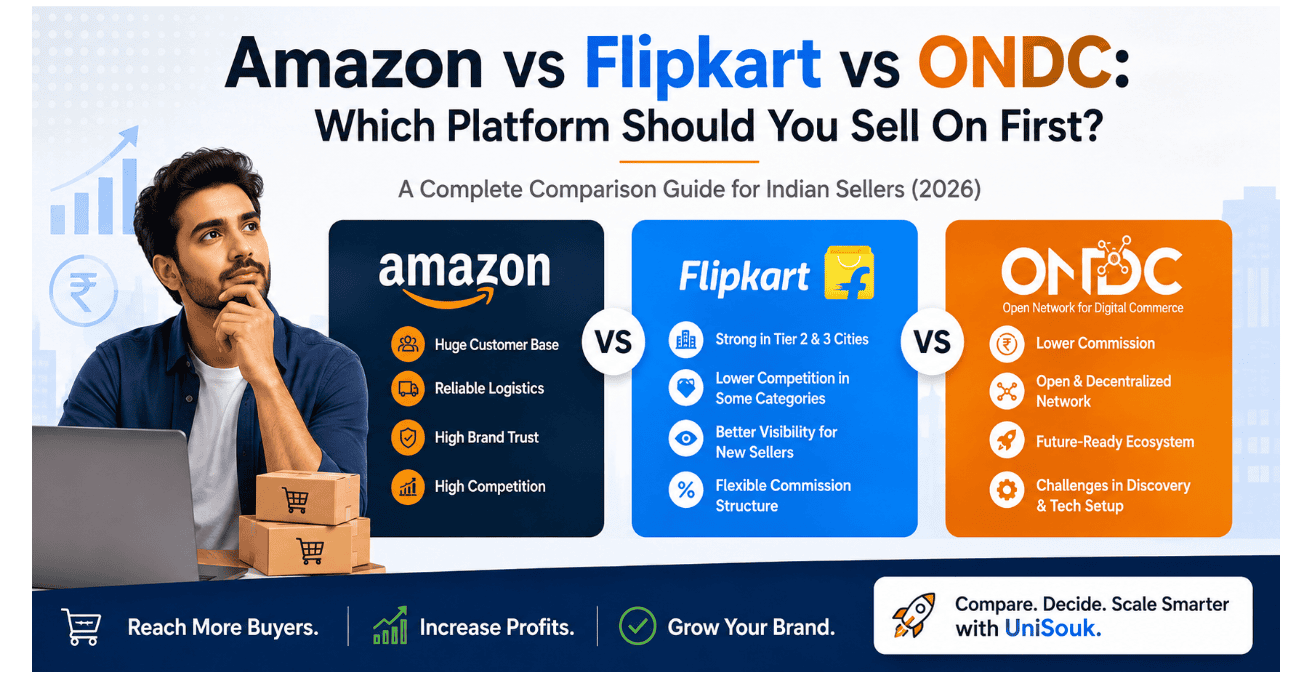
You can lose months by choosing the wrong marketplace first.That first move shapes your fees, margins, ad spend, speed of sales, and how much manual work lands on your plate.
If you're comparing Amazon vs Flipkart for India sellers, with ONDC now in the mix, the right answer isn't the same for everyone.A premium skincare brand, a budget fashion seller, and a regional home decor business should not make the same call.
Amazon vs Flipkart vs ONDC at a Glance for India Sellers
Here's the short answer.
If you want fast sales, start with Amazon. If you want strong India-first demand in value categories, start with Flipkart. If you want lower fees and more control, start with ONDC.
This table gives you the quick trade-off.
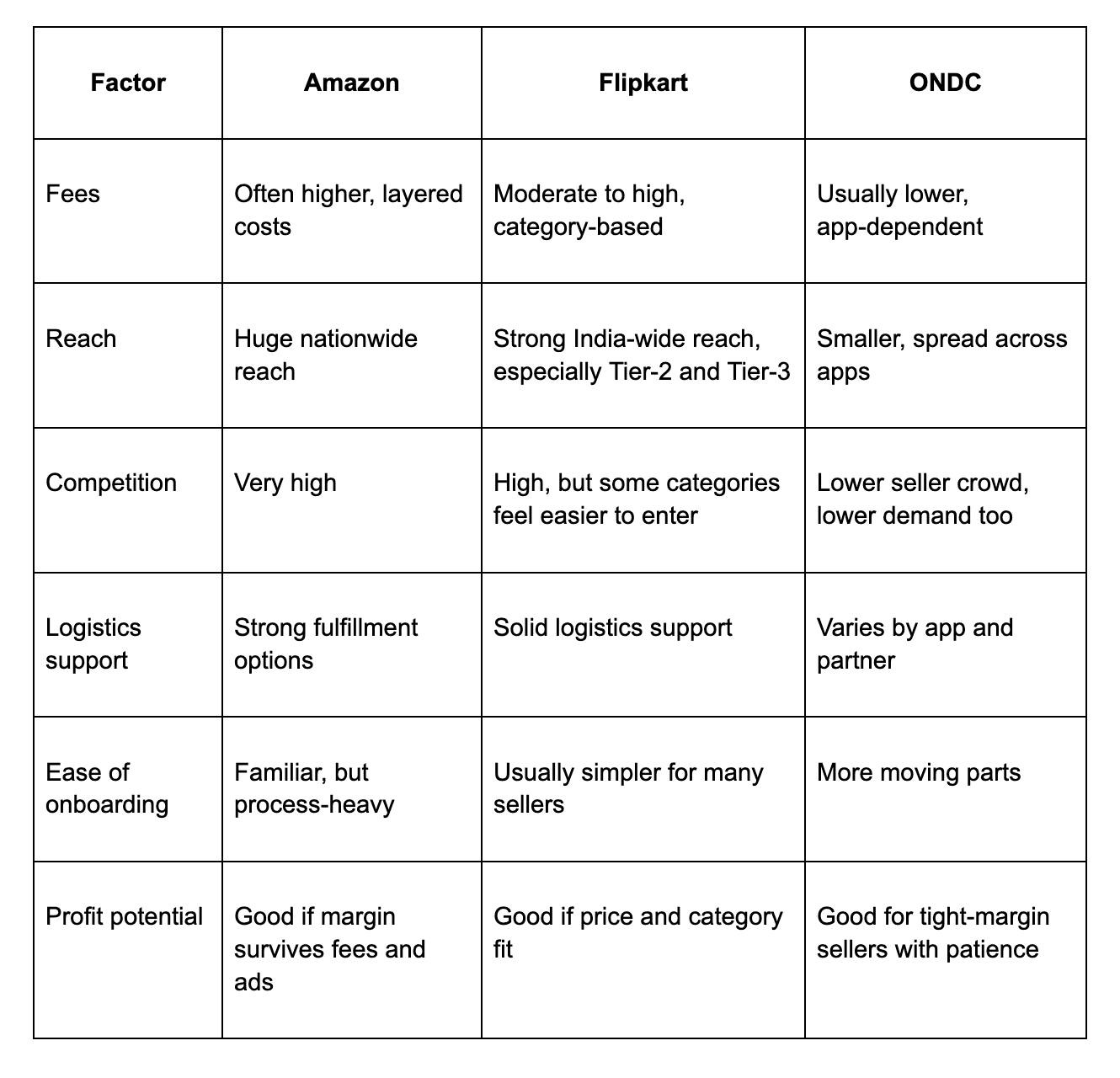
Amazon usually wins on traffic. Flipkart often works well for India-focused, price-sensitive demand. ONDC can win on cost and control, but not yet on predictable volume.
What Amazon Gives You, and Where It Costs More
Amazon is often the first choice when you want scale fast. The buyer trust is already there. Prime has weight. Fulfillment is mature. If your listing is good and your price is right, orders can start faster than on most newer channels.
Why Amazon Works Well for New Sellers Who Want Reach Fast
You don't have to build the mall, you only need to get noticed inside it. That's Amazon's biggest strength.A branded supplement, a private-label kitchen product, or a fast-moving electronics accessory can find demand across India without waiting for one city or one audience pocket to respond.
This is why many Amazon vs Flipkart India sellers start here first. Amazon is strong when you have decent margins, clean catalog content, sharp photos, and enough budget to support ads. For a D2C brand that wants national visibility, it can feel like the quickest launchpad.
What Can Hurt Your Margins on Amazon
Traffic isn't free money. Amazon can chip away at profit from multiple sides: referral fees, fulfillment fees, storage, returns, and ads. If you price too low, the platform can sell your product before you make anything worth keeping.
If you're asking Amazon or Flipkart, which is best, don't stop at order volume. Check your real contribution margin after every cost line. This seller fee breakdown is a useful starting point.
Why Flipkart Can Be a Smart First Move for India-Focused Sellers
Flipkart still matters, a lot. If your products fit Indian mass-market demand, especially fashion, value-led electronics, and everyday home products, Flipkart can be a smart first bet. Its strength outside the biggest metros is hard to ignore.
Where Flipkart Can Give You an Edge Over Amazon
Some categories are simply more at home on Flipkart. If you sell budget-friendly kurtis, affordable kitchen tools, mobile accessories, or seasonal value products, you may find the audience fit sharper. In some niches, it can also feel easier to get discovered without fighting Amazon's full intensity from day one.
A quick comparison for Indian sellers makes this point well: Flipkart often works best when the buyer is price-conscious and the category is built on volume, not premium positioning.
What You Should Watch Before You Start on Flipkart
Don't assume Flipkart is always cheaper or easier. Fees still matter. Returns can sting. Pricing pressure can be brutal in crowded categories. If your product has weak differentiation, a race to the bottom can start fast.
A seller moving budget home storage boxes might do well on Flipkart because demand is broad. A premium handmade candle brand may not. That's the real test. The question is not only Flipkart vs Amazon, which is best. It's which one fits your category, audience, and margin.
Best for: India-focused sellers with value products, strong category fit, and demand beyond metro buyers.
ONDC Explained in Simple Words, and When It Makes Sense First
ONDC is different from both Amazon and Flipkart.
ONDC is a network that lets you sell through multiple buyer apps instead of one central marketplace.
That difference matters. You're not stepping into one closed platform. You're joining an open network where different apps can connect buyers, sellers, logistics, and payments. If you want the basics, this ONDC cost and registration guide lays it out clearly.
Who Gets the Most Value From ONDC Today
ONDC makes the most sense for sellers who care about lower cost, less platform dependence, and more control. That can include MSMEs, local brands, regional product sellers, wholesalers, and businesses with tight margins that can't absorb heavy marketplace charges.
A regional snacks brand is a good example. If your margins are thin and your product already has repeat demand, lower network costs can matter more than flashy traffic. That's why ONDC seller platform options in India are getting attention.
Why ONDC Is Still Harder to Rely On Alone
The problem is reach. Amazon and Flipkart are still stronger for direct sales in 2026. ONDC is growing, but buyer traffic is spread across apps, and the experience can vary. That means less predictable order flow.
An Outlook Business report on ONDC and small sellers captured the promise well, but promise and day-to-day sales are not the same thing. If you start with ONDC alone, you need patience, cleaner operations, and a longer view.
Best for: sellers who want lower fees and more control, and can accept slower early volume.
How Fees, Returns, and Ads Change Real Profit for Amazon vs Flipkart India Sellers
This is the part that decides whether a platform is worth it. Not gross sales. Not dashboard vanity. What you keep.
A fashion seller with a ₹699 kurti may get good volume on Flipkart or Amazon, but a high return rate can wreck the month. An electronics seller moving earbuds may need Amazon's scale because ad spend is easier to justify when the category already has heavy demand. A home decor seller with handmade lamps may prefer ONDC if fees stay lower and brand control matters more than fast volume.
Low fees matter, but traffic, returns, and ad spend decide your real profit.
How Different Product Types Change the Best Choice
If you sell fashion, brand position and return rates matter more than almost anything. Budget fashion often fits Flipkart well. Branded fashion with stronger visuals can work on Amazon.
If you sell electronics, Amazon's reach often makes the math work faster. If you sell a regional or low-margin product, ONDC can look more attractive because every percentage point saved matters.
Why the Cheapest Platform Is Not Always the Best One
A lower commission rate sounds great until the orders don't come. Or until you need to spend more to get seen. Or until returns wipe out the savings.
That's why smart sellers build a simple sheet before choosing. Product cost, platform fee, shipping, return loss, ad cost, and expected conversion. In the Amazon vs Flipkart debate for India sellers, the winner can change from one SKU to the next.
Which Platform Should You Start With, Based on Your Business Stage
If you want a simple framework, use this:
-Start with Amazon if you want reach first and your margin is healthy.
-Start with Flipkart if your product is value-led and built for broad Indian demand.
-Start with ONDC if your fees are tight and you want more control from day one.
A Simple Rule for Choosing Your First Platform
Choose reach first if your margin is strong. Choose affordability first if your budget is tight. Choose control first if you care more about long-term economics than instant volume.
That rule won't solve every case, but it gets you close fast.
Why Multi-Channel Selling Often Wins After the First Launch
Your first platform should not become your only platform. Once you know what sells, multi-channel selling lowers risk and gives you cleaner data on where your best profit comes from. That's where a unified commerce platform for sellers helps, because managing three dashboards by hand gets old quickly.
As you expand, you also need to sync stock across sales channels so one good sales day doesn't turn into overselling and cancelations. If you're using AI Listing Agent tools or bulk catalog workflows, that jump gets even easier.
Start with the platform that matches your margin, not the one with the loudest name. Learn what sells, fix your numbers, then expand.
When you're ready to sell smarter across all three, stop juggling separate panels and move to one system that helps you run them together.
FAQs
1. Amazon or Flipkart, which is best for new sellers in India?
Amazon is often better if you want faster reach and buyer trust. Flipkart can be better if your product is value-led and built for price-sensitive demand.
2. Is ONDC better than Amazon for small businesses?
ONDC can be better on fees and control. Amazon is still better for predictable traffic and faster sales in most categories.
3. Which platform has lower seller fees in India?
ONDC usually has lower commissions. But your real profit still depends on traffic, returns, logistics, and how smoothly you can operate.
4. Can you sell on Amazon, Flipkart, and ONDC together?
Yes, and many sellers should. It lowers platform risk, widens reach, and helps you compare which channel gives you the best margin, not only the most orders.
5. How does UniSouk help ecommerce sellers manage multiple platforms?
UniSouk helps you handle listings, inventory sync, order management, and marketplace integrations from one place. If you're scaling across Amazon, Flipkart, and ONDC, it also pairs well with AI Listing Agent workflows so your catalog work doesn't eat your week.
Conclusion
If you're stuck on Amazon vs Flipkart for India sellers, with ONDC in the background, the clearest answer is this: Amazon is usually the best first move for reach, Flipkart is a strong India-first option for value categories, and ONDC is the better long-term bet when fees and control matter most.

Unify sales, Amplify scales
Registered name : NexaNode Technologies Private Limited.
Address
Sixth Floor, Office No.601, Solaris Cube, Rundh-Vesu, B/s. Rajoo India, Nr. Mitul Square, Vesu, Surat, Gujarat-395007
Phone
+91-9033151267
© 2026 Nexanode Technologies Pvt Ltd. All rights reserved.


