ecommerce business ideas, low investment business, business ideas in India, online business ideas, small business ideas, ecommerce startup India, side hustle ideas, budget business ideas, Indian business ideas
Best Inventory Software for Indian E-commerce in 2026
Compare the best inventory management software in India for e-commerce in 2026. Explore features, pricing, and top tools for Amazon, Flipkart, Shopify, and D2C sellers.
July 8, 2026
Selling on Amazon, Flipkart, Shopify, WooCommerce, Myntra, and your own website sounds exciting until your stock numbers stop matching. In 2026, one bad update can cost you a sale, trigger a cancellation, and hurt trust.
That is why inventory management software matters more than ever. If you want fewer stockouts, faster order flow, and one clean view of stock, this guide will help you compare the strongest options, including UniSouk for Indian multi-channel sellers.
If you want to understand the difference between selling channels before you choose software, you can also read UniSouk’s guide on Amazon vs Flipkart vs ONDC.
Why your e-commerce business needs inventory management software in India
When you sell in more than one place, stock moves fast. A manual spreadsheet might work for a week. After that, it starts lying to you.
The inventory problems that cost you sales every day
You think you have 12 units left. Amazon shows 12, Shopify shows 9, and Flipkart still shows 15. Then one SKU sells on two channels at the same time, and you are stuck refunding one buyer.
That mess is common in India, especially when you manage multiple warehouses, returns, and fast marketplace updates. Missed low-stock alerts, slow sync, and bad counts do not look dramatic on paper, but they drain profit every day.
What better inventory control does for your operations
A solid tool gives you real-time visibility, faster fulfillment, and fewer cancellations. You stop guessing, and your team stops double-checking the same stock again and again.
It also helps you buy smarter. Better reporting means better forecasting, lower dead stock, and fewer panic reorders. For a small seller or a growing brand, that control saves both time and cash.
How You Should Compare The Best Inventory Management Software In 2026
Not every stock tool is built for online selling. Some are better for general retail, while others are made for marketplace-heavy operations.
What matters most when you evaluate each platform
Start with the basics. You need multi-channel sync, warehouse support, marketplace integrations, order management, reporting, and automation that works without babysitting.
Ease of use matters too. If your team cannot learn it quickly, the software becomes one more job. In 2026, the better options also support cloud-based access and clean mobile-friendly dashboards.
For a practical look at inventory planning basics, Amazon Business has a useful guide on ecommerce inventory management.
Why pricing and support can matter more than extra features
The cheapest tool can get expensive when setup drags on for weeks. You feel that cost in missed orders, confused staff, and support tickets.
Fast support, reliable updates, and simple onboarding often beat a long feature list. A practical tool that works every day is worth more than a flashy one your team avoids.
Best E-commerce Inventory Management Software In India For 2026
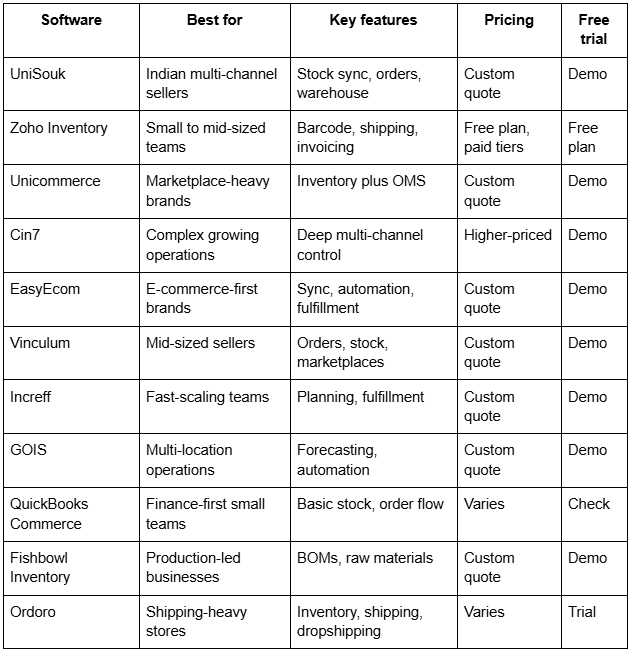
Here is the quick side-by-side view before the short reviews.
If you want India-first depth, UniSouk, Unicommerce, EasyEcom, Vinculum, and Increff deserve a close look.
UniSouk
UniSouk is a strong fit when you want one place to manage Amazon, Flipkart, Shopify, and your own store. You get multi-channel inventory sync, order management, warehouse control, and real-time stock updates in one dashboard.
It is a good fit for growing sellers that need less manual work. If you want to explore the platform in more detail, visit UniSouk or check the inventory and order management page.
Best for: Growing Indian sellers
Pros: Real-time sync, marketplace support, warehouse control
Cons: Best value appears after you start scaling
Pricing: Custom quote, demo available
Zoho Inventory
Zoho Inventory works well for small and mid-sized businesses that want a simpler start. It offers barcode support, shipping tools, invoicing, and marketplace sync.
The upside is ease of use and a free entry point. The downside is that larger operations may outgrow it.
Best for: Small businesses
Pros: Simple setup, useful core features, free plan
Cons: May feel limited for more complex operations
Pricing: Free plan and paid tiers
Unicommerce
Unicommerce fits sellers who live on marketplaces and need tighter fulfillment workflows. It handles multi-channel operations well and is widely used in India.
You get strong control, but setup and pricing usually make more sense for serious volume.
Best for: Marketplace-heavy brands
Pros: Strong India focus, reliable fulfillment workflows
Cons: Better suited to larger operations
Pricing: Custom quote
Cin7
Cin7 is better for growing brands with more moving parts. It offers strong inventory control, broad channel support, and deeper automation.
The tradeoff is cost. It is more suited to teams that already have scale.
Best for: Growing brands
Pros: Strong multi-channel sync, advanced control
Cons: Higher cost, more complex than simple tools
Pricing: Higher-priced, quote-based
EasyEcom
EasyEcom is built with e-commerce-first workflows in mind. It helps with stock sync, order automation, and fulfillment across channels.
You get useful marketplace support, though smaller teams may want to compare pricing closely. Their blog also shares useful India-focused operations insights on multi-marketplace selling.
Best for: E-commerce-first brands
Pros: Good automation, marketplace support
Cons: Pricing may need careful review
Pricing: Custom quote
Vinculum
Vinculum is a good match for mid-sized sellers that need stronger control across marketplaces and stores. It combines inventory, order, and channel operations well.
It is solid for growth, though it may feel heavier than lightweight tools.
Best for: Mid-sized sellers
Pros: Good channel control, useful for multi-store operations
Cons: Can feel heavy for small teams
Pricing: Custom quote
Increff
Increff works best for fast-scaling e-commerce businesses. It focuses on inventory planning, fulfillment speed, and cleaner operations at scale.
If your problem is complexity, not basics, this one deserves attention.
Best for: Fast-growing teams
Pros: Strong at scale, useful for planning and fulfillment
Cons: May be more than small teams need
Pricing: Custom quote
GOIS
GOIS is worth a look if automation, forecasting, and multi-location sync are high on your list. It is useful when you want tighter stock planning across locations.
Compare it carefully against India-focused rivals on support and integrations.
Best for: Multi-location businesses
Pros: Forecasting, automation, location-based control
Cons: Needs a close integration check
Pricing: Custom quote
QuickBooks Commerce
QuickBooks Commerce appeals to small businesses that want finance and stock closer together. It can handle basic inventory and order automation well enough for simpler setups.
Marketplace-heavy Indian sellers may still want a more e-commerce-focused tool.
Best for: Small teams with simpler needs
Pros: Finance and inventory together, easy basics
Cons: Not ideal for complex marketplace selling
Pricing: Varies
Fishbowl Inventory
Fishbowl Inventory makes more sense when you also deal with production, materials, or work orders. BOMs and raw material tracking are its strong side.
If you only sell finished goods online, it may be more software than you need.
Best for: Production-led businesses
Pros: BOM support, raw material tracking
Cons: Not built only for e-commerce
Pricing: Custom quote
Ordoro
Ordoro is useful for shipping-heavy and dropshipping stores. It combines multi-channel selling, inventory, and shipping tools in one system.
If dispatch speed is your pain point, it is a practical option to compare.
Best for: Shipping-heavy stores
Pros: Shipping focus, dropshipping support
Cons: May not suit every India-first workflow
Pricing: Varies
Which Inventory Software Fits Your Business Type Best?
A tool can look great on paper and still be wrong for your store. The best fit depends on how and where you sell.
Best inventory software for small businesses
Zoho Inventory is often the easiest starting point. UniSouk also makes sense if you are small but already selling on multiple channels and want room to grow without changing systems too soon.
If you want to start simple, UniSouk’s pricing is a good place to compare options before booking a demo.
Best inventory software for Amazon and Flipkart sellers
UniSouk, Unicommerce, EasyEcom, and Vinculum are strong picks here. You need fast stock sync, reliable marketplace updates, and fewer overselling mistakes. That is where these tools earn their keep.
Best inventory software for Shopify and D2C brands
Shopify-first and D2C brands usually care about clean reporting, order flow, and multi-channel stock control. UniSouk, Zoho Inventory, and Cin7 fit well, depending on how complex your operation is.
Best inventory software for larger and fast-growing teams
If you run bigger teams, more warehouses, or high order volume, look at Cin7, Increff, Unicommerce, and Vinculum. They handle scale better and offer tighter operational control.
Features You Should Not Skip When Buying Inventory Management Software
Before you compare pricing or request a demo, check the features that affect your day-to-day work.
Real-time stock tracking across every sales channel
If your stock does not update live, the rest barely matters. Real-time tracking is the heart of multi-channel inventory management software, especially when one SKU sells across several platforms at once.
Marketplace and store integrations that save time
Amazon, Flipkart, Shopify, WooCommerce, and your own site should connect without messy workarounds. Good integrations cut manual uploads and keep your catalog, orders, and stock aligned.
Warehouse, order, and barcode tools that reduce mistakes
Warehouse management, order routing, barcode support, and accurate picking all reduce human error. These features matter more than they sound. One wrong pick can turn a profitable order into a return.
Reports, demand forecasting, and low-stock alerts
Clear reports help you buy better and protect cash flow. You should be able to spot fast movers, slow movers, reorder points, and low-stock risks without opening five different files.
How To Choose The Right Inventory Management Software For Your Store
Think about your store today, then think six months ahead. The right tool should fit both.
Match the tool to your order volume and sales channels
A store with 200 orders a month does not need the same setup as one shipping 20,000. Count your monthly orders, your warehouse count, and every place you sell before you shortlist anything.
Check setup time, support, and future growth needs
Busy teams need easy onboarding and quick support. You also want a system that can scale when you add warehouses, channels, or a larger operations team. Switching later is never fun.
Use demos and trials to test the real user experience
Always test stock sync, dashboard clarity, and team workflows before you buy. Ask for an inventory management software demo, compare pricing, and run a few real tasks, not just a sales walkthrough.
Why More Indian Sellers Are Choosing Unisouk For Inventory Control
A lot of sellers do not want five separate tools for stock, orders, and marketplaces. They want one dashboard that cuts noise.
How UniSouk helps you manage inventory across channels
UniSouk centralizes stock updates across Amazon, Flipkart, Shopify, and your own site. That means less manual work, faster updates, and fewer mistakes when one item sells in more than one place.
Why growing sellers like a single platform for stock and orders
When stock, orders, and warehouse activity live together, your team moves faster. You get better control, cleaner operations, and an easier path to scale without patching together extra tools.
If you want to see how this works in practice, contact UniSouk here and ask for a demo.
Ready to simplify inventory management across Amazon, Flipkart, Shopify, and your own website? Explore UniSouk's all-in-one e-commerce platform and see how you can automate inventory tracking, reduce stock errors, and scale your online business faster. Request a demo today.
Conclusion
The best inventory management software depends on your business size, sales channels, and how fast you are growing. For smaller teams, Zoho Inventory is easy to like. For India-focused multi-channel selling, UniSouk, Unicommerce, EasyEcom, and Vinculum are strong choices. For larger operations, Cin7 and Increff make more sense.
What matters most is fit, not feature overload. Compare integrations, pricing, support, and demos before you commit. If you want tighter control across Amazon, Flipkart, Shopify, and your own store, UniSouk is one of the clearest options to put on your shortlist.